Public Speaking
I have been an invited speaker to several conferences to present or lead a hands-on workshop. In addition, I've led a few webinars.
2019
Unleash the Snariables!
Variables are a great way to add variety and consistency to your Flare projects. Chances are, you’re using only a fraction of the functionality they provide. If you're using a Don't Repeat Yourself (DRY) coding methodology, variables will make your life much easier as you can build re-usable components combining snippets and variables.
In this session, we’ll look at the basics of variables and explore the variable file and how you add them to your topics. We'll review the types of variables (ones you define and ones generated by the system), cover best practices, demonstrate adding variables using the XML editor, and show you how to inject variables within the text editor to provide variety such as changing background colors or images for an element or an entire page, or constructing URLs for links.
You'll leave with several examples, inspired to look for opportunities to use variables within your projects to take full advantage of their power.
Bling for Side Menus, Drop-Downs, and Other Auto-Generated Components
MadWorld Conference
You've designed a great site and built it, but feel it needs just a little more visual bling for the side menu. Trouble is, there are no styles to modify and only so much you can do in the skin editor. Or maybe you have dropdowns within dropdowns. Oh my.
In this session, we'll review the available style settings and whether to leave them as is if you plan to modify them.
Then we'll begin the detective work to discover the styles that Flare creates for slideshows, menus, dropdowns, toggles, and other containers. We'll cover the Inspect Element command and tools on Chrome and Firefox and how you can prototype and test the function of the built page.
Next, we'll review some samples and go over the coding that made it happen. We're going to dive into the style definitions, so you should be comfortable editing CSS as text.
You'll leave with some commented placeholder styles you can copy into your style sheet and customize to give your site its own distinctive style.
Expert Panel Q&A (panel)
2016
Case Study: A Flare for Training – Integrating Instructional Design into MadCap Flare Projects
MadWorld
Co-presented with Andrea Maliska of Rebel Learn

Make Your Website a Superstar!
STC Sacramento
Three lightning talks by Homer Christensen
-
Semantic Markup in HTML5
-
Using jQuery on your Site
-
Responsive Web Page Elements using Flexbox
2015
Live Webinar Customer Showcase: Developing Modern Responsive Help Sites with MadCap Flare 11
MadCap Software webinar
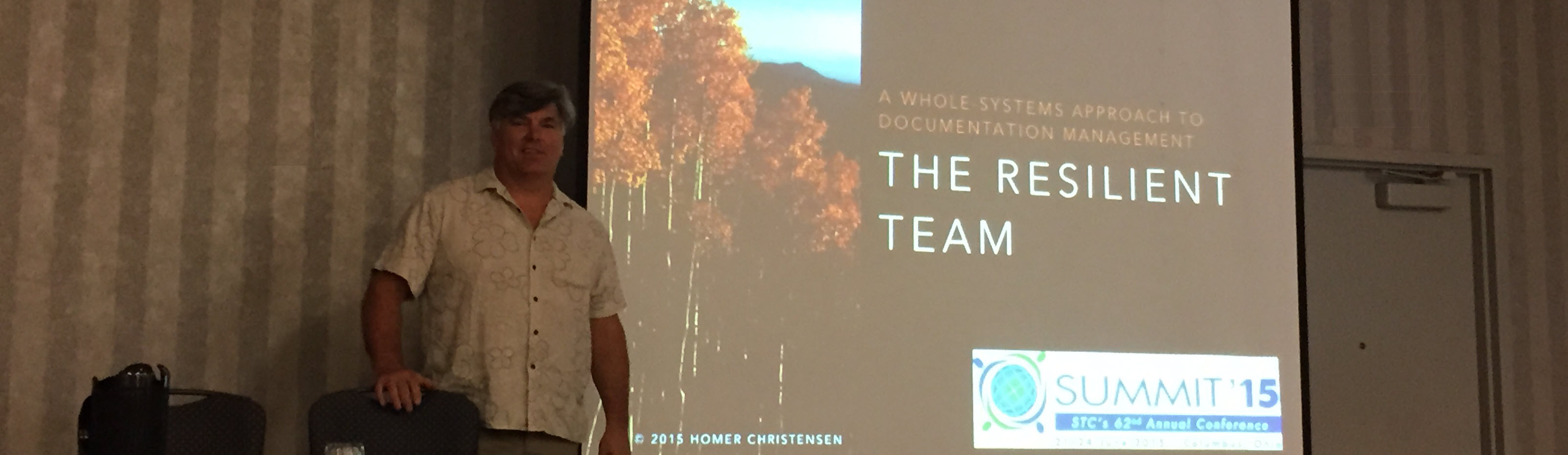
The Resilient Team: A Whole-Systems Approach to Documentation Management
Society for Technical Communication Summit
2014
Flow: A Permaculture Approach to Documentation Projects
Write the Docs
Permaculture is all the rage in the organic and urban farming circles, but it is a design science rooted in observation that has applications far beyond vegetables and fruits. Its basic tenets include observing the environment to discern the patterns, the risk areas, and other factors that will influence your work, and then working within those constraints using the least amount of energy and costly outside inputs to produce a harmonious, sustainable, and perennial system that yields a healthy return and requires the least amount of work to maintain.
This presentation introduces some of the core practices of permaculture that can be immediately applied to any project to make it more successful, more enjoyable, and better suited to its intended audience.
Participants will discover:
-
Why it is important to design from the patterns to the details.
-
The edge where two systems meet (think engineering and customer service) yields the most innovation.
-
Diversity is important to incorporate and honor.
-
Ways to stack function… where one element performs multiple roles (like single-sourcing).
-
How to plan for zones of access… so that your audience can quickly locate the most important, most frequently used information.
It’s a fresh and intuitive approach, a Zen view of something that many of us have done for years. In Permaculture, the problem is the solution. Or perhaps more properly said: in any problem lies the solution.